AI Concepts Primer
This post offers a quick introduction to key AI concepts—from the origins of artificial intelligence to today’s powerful large language models and AI agents. Incliuding cool concepts like an AI Operating System.
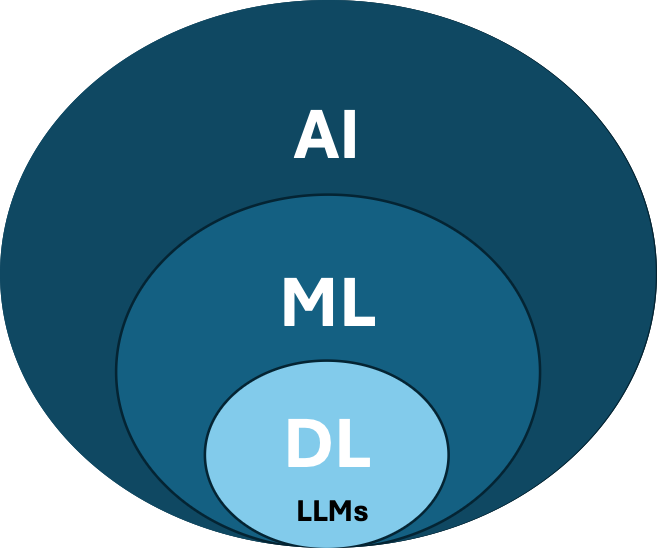
Artificial Intelligence (AI) [1] is “the science and engineering of making intelligent machines.” Standford Prof. J. McCarthy coined the term in 1955 with giants such as Nathaniel Rochester, Prof. C. E. Shannon, Prof. M. Minsky. AI is an umbrella term that encompasses all the below.
Machine Learning (ML) [1] “is the part of AI studying how computer agents can improve their perception, knowledge, thinking, or actions based on experience or data”. There is a feedback mechanism to improve the models. ML is also an umbrella term that also encompasses all the below, but since the next sub-category has become so successful, “Deep Learning” has taken the spotlight over ML.
Deep Learning (DL) [1] “is the use of large multi-layer (artificial) neural networks that compute with continuous (real number) representations, a little like the hierarchically organized neurons in human brains . It is currently the most successful ML approach.” The first artificial neuron was designed by W. McCulloch and W. Pitts in 1943, to be implemented by F. Rosenblatt in 1957. It was not until G. Hinton, Y. Bengio, and Y. LeCun, with their new foundational concepts and experiments, together with the improvements in hardware for training these networks and the use of data at scale, that deep learning became performant and progressively mainstream.
Generative AI (GenAI) “is a type of AI technique that generates synthetic artifacts by analyzing training examples; learning their patterns and distribution; and then creating realistic facsimiles. GenAI uses generative modelling and advances in deep learning (DL) to produce diverse content at scale by utilizing existing media such as text, graphics, audio, and video […]. A key feature of GenAI is that it generates new content by learning from data instead of explicit programs.” [3, 4] There are four typical structures for outputs: sequential (like text, music, code, time-series, etc.), tabular (tables of rows and columns), graph (generation of network structures like social ones, molecular structures, or recommendation systems), and spatial (2D images, 3D models, video) [2].
A language model is a model of natural language useful for tasks like speech recognition, machine translation, natural language generation, handwriting recognition, etc. [5].
A large language model (LLM) is a type of machine learning algorithm designed for natural language processing (NLP) tasks like language generation, and has been extended to work with generating music, video, images, etc. LLMs are trained on vast amounts of text, image, video, music, code data, may have billions of parameters (hence “Large”), which enables them to learn patterns, relationships, and structures of language. [6]
Types of LLMs and use cases:
- Text-to-Text: Translation, summarization, question-answering
- Voice-to-Text: Speech recognition
- Text-to-Image: Image generator
- Text-to-Video: Video generator
- Omni (multimodal): Models capable of handling various types of input and generating various types of output
Generative pre-trained transformers (GPT) are a specific type of LLM. Its acronym means:
- Generative: Generate new output (text, images, etc.)
- Pre-Trained: Learned from data and there is still room for fine tuning with additional training.
- Transformer: Specific type of neural network. The core of the boom in AI.
Pre-trained transformers are also known as foundational models, which then they can be fine-tuned for specific tasks with reinforcement learning (including with humans in the loop). These foundational models are very large and costly to produce.
These pre-trained transformers, the tuned parameters of the underlying model, could be seen as a lossy compression of the Internet.
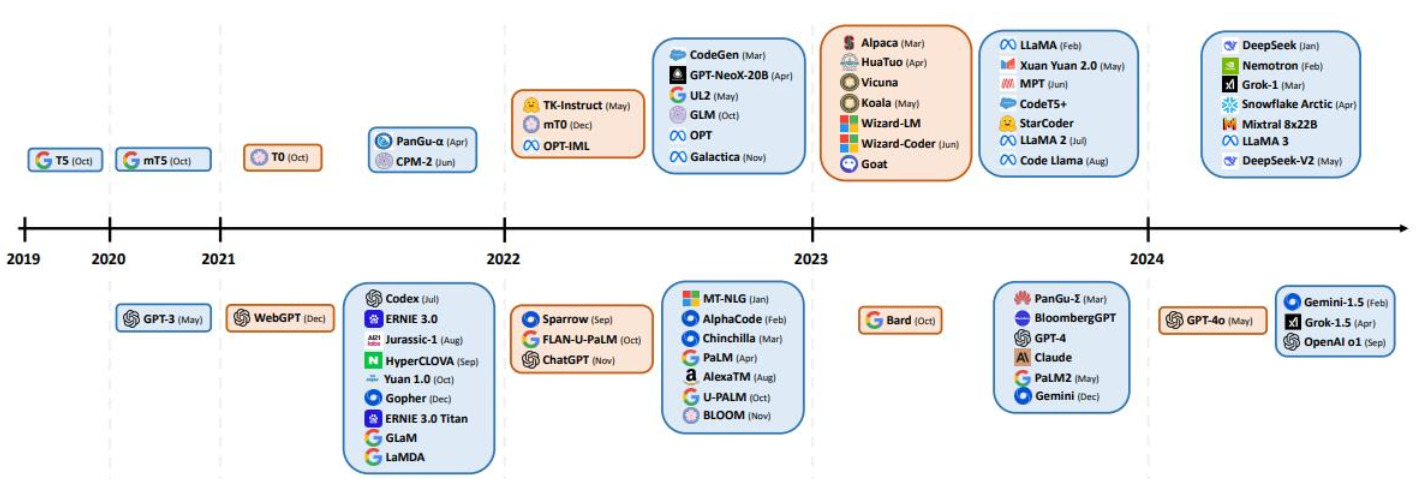
The below is a “chronological display of LLM releases: Blue cards represent pre-trained models [models that have been trained on large amounts of data in a general, unsupervised or self-supervised way (e.g., predicting the next word)], while orange cards correspond to instruction-tuned models [models that start from a pre-trained base and are then fine-tuned using supervised instruction data (and sometimes reinforcement learning with human feedback)]. Models on the upper half signify open-source availability, whereas those on the bottom are closed-source. The chart illustrates the increasing trend towards instruction-tuned and open-source models, highlighting the evolving landscape and trends in natural language processing research.” [6]
AI agents, or agentic AI, are “intelligent agent[s] capable of autonomously executing appropriate and contextually relevant actions based on sensory input, whether in a physical, virtual, or mixed-reality environment.” [7]. The agents’ capabilities are: learning, memory, action, perception, planning, and perform other cognitive aspects like adaptability, goal-orientation, rationality, among others.
There are different levels of agents (see informally in reference [8]). Currently, current AI is far from doing all the above, but that’s the goal of every AI or cutting-edge company in tech. Agents are the next big step after ChatGPT’s big moment. This time, it is likely to be even more impactful.
An OS to support an AI (AIOS) [9]. AIOS refers to a hypothetical idea whereby an OS is designed to support and manage AI applications and processes.
The below image is a design of an OS to serve LLM-based AI agents specifically:
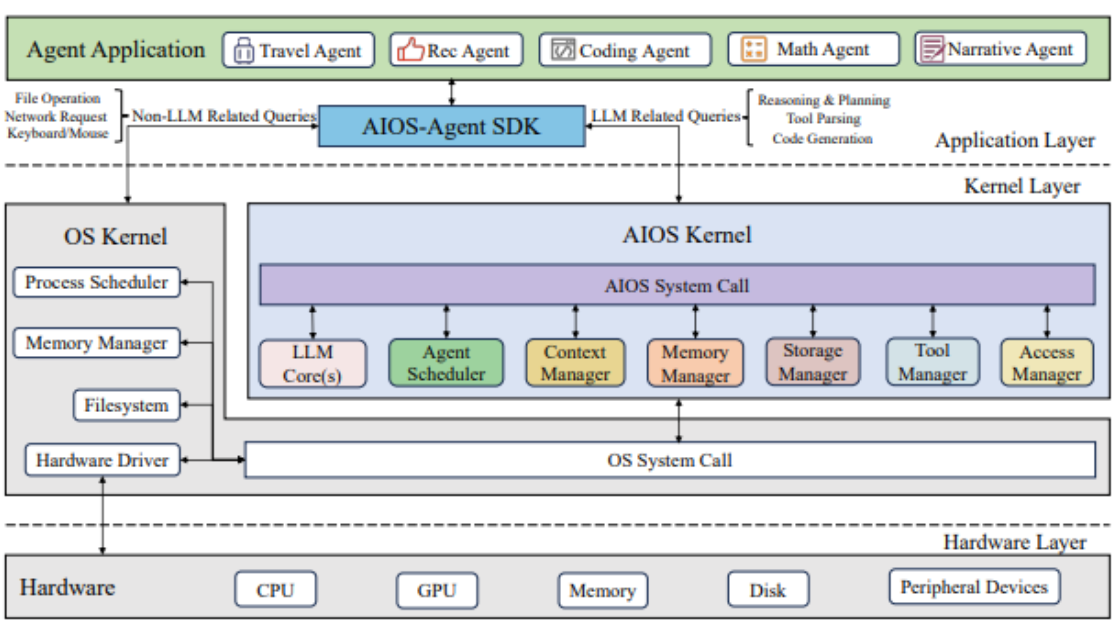
Figure from [9], “An overview of the AIOS architecture where responsibilities are isolated across different layers. Application layer facilitates the design and development of agent applications. Kernel layer manages core functionalities and resources to serve agent applications. Hardware layer controls and manages physical computing resources and devices to support kernel layer functionalities.”
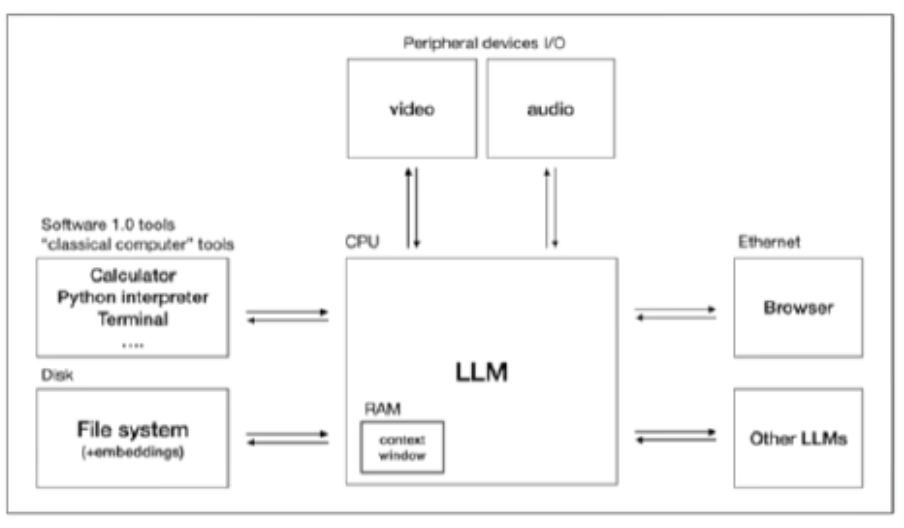
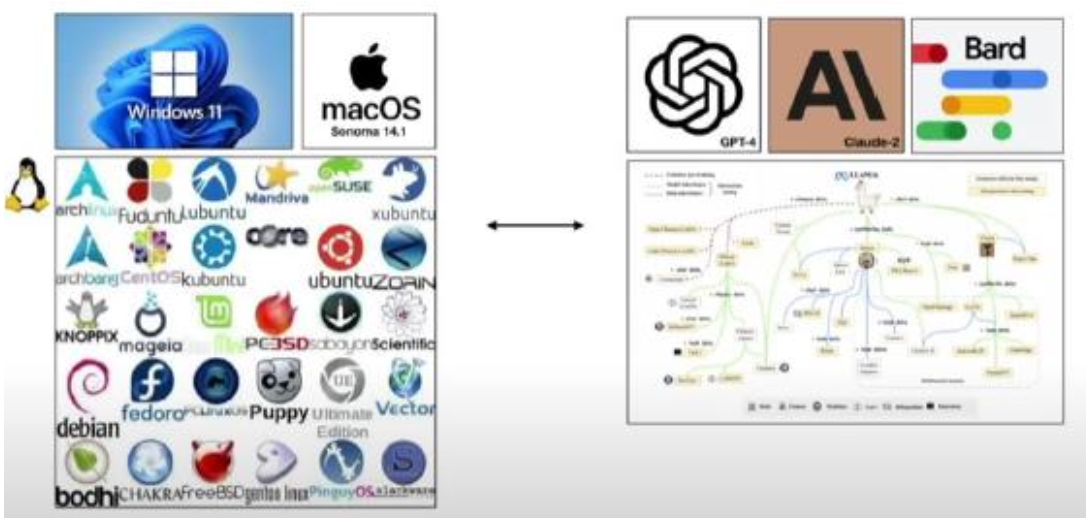
One can also see below a simplified and analogical version of how an LLM, in some way, may “act” as an OS [10].
The above more-involved picture from [9] includes layers added to an existing OS architecture to enable AI agents.
And the parallels it has with OSes [10]:
Donations
Feeling generous? Toss a coin to your blogger via Paypal 😀
References
[1] AI definitions
http://rehttps/hai.stanford.edu/sites/default/files/2020-09/AI-Definitions-
HAI.pdf
[2] Generative AI for visualization: State of the art and future directions
https://www.sciencedirect.com/science/article/pii/S2468502X24000160
[3] A Survey of Unsupervised Generative Models for Exploratory Data Analysis and Representation Learning.
https://dl.acm.org/doi/10.1145/3450963
[4] A Review on Generative Adversarial Networks: Algorithms, Theory, and Applications
https://ieeexplore.ieee.org/document/9625798
[5] Language model
https://web.stanford.edu/~jurafsky/slp3/3.pdf
[6] A Comprehensive Overview of Large Language Models
https://arxiv.org/pdf/2307.06435
[7] Position Paper: Agent AI Towards a Holistic Intelligence (from Microsoft)
https://arxiv.org/pdf/2403.00833v1
[8] Understanding And Preparing For The 7 Levels Of AI Agents (Forbes)
https://www.forbes.com/sites/douglaslaney/2025/01/03/understanding-and-preparing-for-the-seven-levels-of-ai-agents/
[9] AIOS: LLM Agent Operating System
https://arxiv.org/pdf/2403.16971
[10] Intro to Large Language Models
https://www.youtube.com/watch?v=zjkBMFhNj_g&t=256s
[11] An interdisciplinary account of the terminological choices by EU policymakers ahead of the final agreement on the AI Act: AI system, general purpose AI system, foundation model, and generative AI
https://link.springer.com/article/10.1007/s10506-024-09412-y
Disclaimer
Any views expressed in this post are solely those of the author and do not represent the opinions or policies of any affiliated organizations.